I am Korean, and my husband is Polish. After getting married and settling in Poland, I found myself facing a big question during my pregnancy:
“What language will our children speak? Will they be able to speak Korean well?”
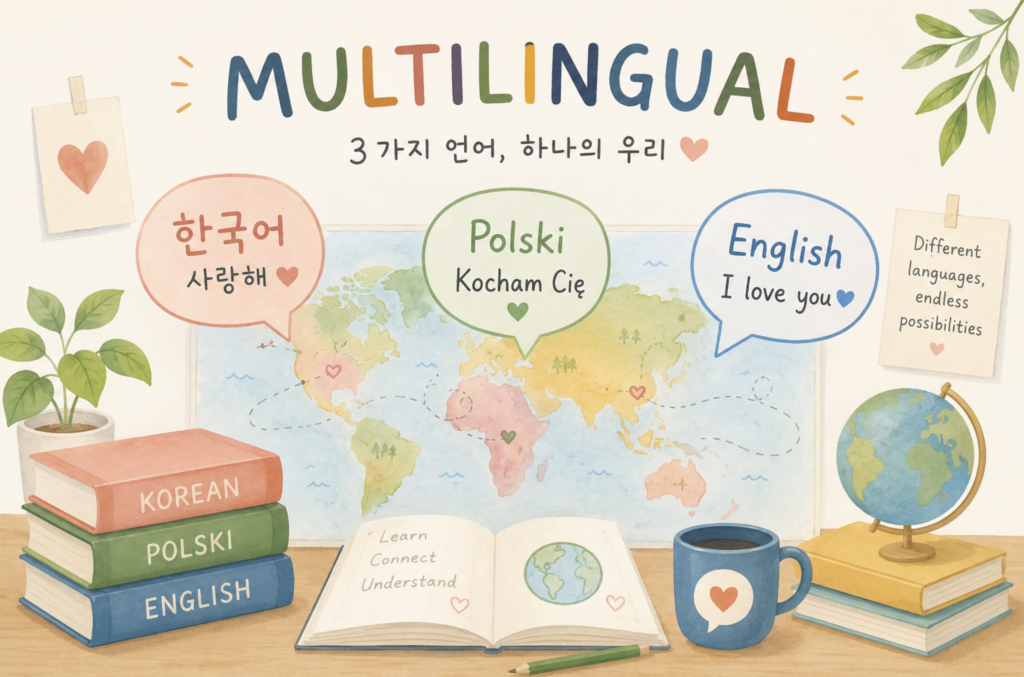
Unless we decide to send our children to an international school, they will attend Polish preschools and schools. My husband and I have always spoken English to each other, and we did not want to change that. So, quite naturally, our home would become a multilingual environment where three languages—Korean, Polish, and English—would coexist.
Of course, I would love for our children to acquire all three languages. But I also had some concerns. Is teaching children as many languages as possible always a good thing? Could they end up not developing any one language deeply enough? Would they fall behind their peers linguistically once they started school?
These concerns were not purely hypothetical. Having lived and worked in Europe, I had heard many stories from colleagues and more experienced parents raising children in multilingual families.
- Some children spoke Korean quite well when they were young but became much more comfortable with the local language after starting school. By adolescence, they found it difficult to express complex thoughts and emotions in Korean and eventually started avoiding conversations in Korean altogether.
- I also heard about families where the parents were not fluent enough in the local language, and the children were not confident in Korean either. Over time, conversations between the parents and children became less frequent, and the children sometimes became reluctant to invite their friends over.
- In some families, teachers even recommended additional language support after the children started school because they had a smaller vocabulary than their local peers.
So, based on these experiences, advice from other parents, and the information I found through my own research, I decided to establish three principles for our family:
- Decide from the beginning which languages each parent will use with the children—and which language the parents will use with each other.
- Make Korean the only language used for TV shows and videos.
- Create happy memories associated with Korea.
Here is how we came up with these principles and how we have been putting them into practice in our family.
1. Our Family’s Multilingual Rule: Korean with Mom, Polish with Dad
The language rules in our home are quite simple:
- Mom (me) → Children: Korean
- Dad → Children: Polish
- Me ↔ My husband: English
This approach is commonly known as OPOL, or One Parent One Language. OPOL is just one approach to multilingual parenting, and in reality, the language environments of international families can look very different. For example, the families I know have taken very different approaches:
- I know a Korean mother who speaks both Korean and English with her children, while her Polish husband speaks both Polish and English. Their child naturally understands and uses all three languages.
- Another family I know decided from the beginning to make English their home language because they wanted their children to be able to understand their parents’ conversations and share thoughts with both parents naturally. As the children grew older, they became highly proficient in English, but their interest in Polish and Korean decreased, eventually leading the family to choose an international school.
In the end, I believe that what matters most is not following one particular methodology, but finding a system that fits your family’s environment, the parents’ language abilities, and the child’s personality—and then sticking with it consistently.
So, Are We Not Teaching Our Children English?
After giving it a lot of thought, we decided not to actively teach English for now. The main reason was that I did not feel confident enough to raise my children in English. Using English for business or everyday adult conversations is completely different from expressing emotions, setting boundaries, disciplining a child, comforting them, and communicating at their level.
So we decided that I would speak Korean—the language I can use most naturally and expressively—with our children, while my husband would speak Polish, his native language and the language spoken around us. For now, English would remain the language my husband and I use with each other, and we would let the children learn it naturally through their school curriculum.
There has also been an unexpected little advantage to using English between us. It also means we can still have certain conversations in front of the kids without them understanding everything. We could casually say things like, “Let’s take the kids to the park and get them some ice cream today.” Of course, whenever we used a word that sounded similar in Korean and English, such as “ice cream,” we sometimes spelled it out—“I-C-E”—just in case the kids caught on.
But now that our oldest has started learning English at preschool, he has gradually begun understanding more and more of what we say in English. It seems our once-secret language is slowly approaching its expiration date.
Suddenly, He Started Code-Switching
Our oldest was an early talker. At around 22 months, he was already trying to recite poems he had learned at daycare. But strangely enough, about 80% of the time, he spoke Polish to me. I think this was because he often saw me speaking Polish with my mother-in-law, and he knew that I could understand Polish.
Then, when he was around two and a half, we visited a friend who lives in the Netherlands. A group of international couples had gathered together: three Korean women, each married to a man from a different country—the Netherlands, Switzerland, and Poland.
Right after we returned from that trip, something fascinating happened. It was almost as if a switch had been flipped in his brain. He suddenly started choosing his language depending on who he was talking to. He spoke Korean with me and Polish with his dad.
Of course, I cannot say for certain that the trip itself caused this change. He may simply have been reaching the stage of development where he was naturally learning to distinguish between languages. Still, it was the first time I really felt that having one person consistently use one language with him was actually helping.
2. The Most Practical Way to Maintain Korean in Poland: Korean-Only Screen Time
There was one piece of advice I heard over and over again from more experienced parents:
“Make sure TV shows and videos are in Korean.”
Living in Poland, it is difficult to create opportunities for our children to encounter Korean naturally. Once children start daycare or preschool, they spend most of their day hearing Polish and communicating with their friends in Polish. Once they start school, the proportion will become even greater.
In a multilingual environment, the amount of exposure to the language used in society can become dramatically greater than exposure to the language used at home. As a result, the minority language spoken at home can easily be overtaken by the majority language spoken in the wider community. In our family, that minority language is Korean. So we decided to use screen time specifically as an opportunity for Korean exposure.
We Tried to Wait Until Age Two
On weekends at my in-laws’ house, our oldest would sometimes watch TV with his older cousins. At home, however, we tried to delay regular screen time for as long as possible.
Based on the screen-time recommendations for young children that we were following at the time, we rarely showed him videos before he turned two. Instead, we read books in Korean, played Korean nursery rhymes, and had video calls with his maternal grandparents in Korea.
I considered video calls differently from regular screen time. A video call is an actual interaction: the person on the screen talks to the child, the child responds, and they look at each other, laugh, and react to one another. So we treated video calls with Grandma and Grandpa separately from ordinary screen time.
Once he turned two, we started allowing about 30 minutes of screen time a day specifically for Korean exposure. At first, we showed him all kinds of different content via YouTube, but eventually we settled on <Robocar Poli>. When we used YouTube Kids, showing one video often led the algorithm to recommend more similar videos. Unfortunately, some of the recommended content was not particularly suitable for a young child. Our son also started noticing the more stimulating thumbnails and asking us to show him new videos.
Eventually, we decided to subscribe to Netflix and Disney+ so that we could compare them as safer, ad-free alternatives.
Why We Eventually Settled on Disney+
Netflix had a huge variety of content. However, because we were using Netflix in Poland, there were very few children’s shows and movies available with Korean dubbing.
Disney+, on the other hand, worked quite well for us. Perhaps because many Disney, Pixar, and Marvel titles are released internationally, they often offer a wide range of audio and subtitle options. And, importantly for us, most of the content we wanted to watch was available with Korean audio. We chose Korean audio for the kids watching the content and English subtitles for my husband, who was watching along with them.
Another factor was that our son became obsessed with Spider-Man and the Avengers. At first, we moved back and forth between YouTube Kids and Disney+, choosing age-appropriate content. Eventually, he started insisting on Marvel movies and shows, and from that point on, Disney+ became a fairly important source of Korean exposure in our home.
Of course, Disney+ cannot replace actual language learning. The most important part of a child’s language development is still direct interaction with other people. Videos are essentially one-way communication, so simply watching them does not suddenly make a child fluent. So we tried to maximize the benefits of screen time by talking about things they had just watched or playing pretend games with toys, such as Spider-Man figures, and encouraging them to use expressions they had picked up from the show.
As Our Second Child Grew, Our Screen-Time Rules Changed a Little
Our second child, who is now 28 months old, started clearly expressing what he wanted to watch at around 26 months. So we began letting each of the two older children choose a video for about 20 minutes.
Even though that meant they could watch for a total of 40 minutes when they watched together, they still complained every day that it wasn’t long enough. To ease their frustration a little, we recently started adding about five minutes of short educational content from YouTube Kids as a bonus. For this bonus time, I chose <Numberblocks>, which is widely praised for helping young children develop early numeracy skills.
<Numberblocks> is available on YouTube Kids. Unlike Disney+, YouTube Kids has the advantage of offering a much wider selection of content, but it also requires a little more parental supervision. Whenever an unwanted video or content we don’t want the children to see is recommended, we block it immediately through the mobile app.
3. More Important Than Studying Korean: Creating Happy Memories in Korea
After hearing so many different stories from other families, I came to believe that one thing matters more than anything else: Instead of making children “study” Korean, make them love Korea.
Our oldest has visited Korea three times so far. The most recent trip was in November 2025. Before that, we went when he was around one and again when he was around two. He was too young to remember much from the first two trips. But because we had frequently video-called his grandparents in Korea, I think we were still able to maintain a fairly close emotional bond between him and his grandparents.
So when I decided to travel to Korea alone with our oldest last winter, I set myself one simple goal: “I want him to come away thinking, ‘Going to Korea is so much fun!’”
There aren’t as many things to do in Korea during the winter, but I tried my best to come up with ideas.
- I planned our days so that we could visit a new place or have a new experience whenever possible.
- When meeting my friends, I tried to arrange playdates at kids’ cafés or at the homes of friends who had children. Instead of choosing places where the adults could sit and talk, I prioritized places where my son could play with new toys and interact with other children.
- My parents prepared his favorite foods in advance and always respected his preferences when choosing what to eat. They especially made sure he always had his favorite strawberries available.
Ending the Trip with the Joy of Spending All His Money
One unexpected experience from this trip has stayed with me. My parents offered to give my son some spending money. I was a little skeptical because I didn’t think he was old enough to understand the concept of money properly.
But he absolutely loved receiving it. My mother even gave him a little wallet, and our relatives and neighbors kept giving him small amounts of money. He happily collected the money as if it were a game. The problem was that there wasn’t really anything for him to spend it on, so I felt a little disappointed.
Then, just before flying back to Poland, we stayed one night in Incheon. There was an arcade in the hotel. The moment my son saw it, his eyes widened. He desperately wanted to play. So I told him: “Sure. You can spend as much as you want using your own money.” He was absolutely delighted. He seemed to discover the pure joy of spending money.
Looking back, I think what mattered that day was not the fact that he spent his money. It was the memory he created: “In Korea, I got to do what I wanted to do.” And I think memories like this are ultimately connected to language, too. Korean is not simply the language Mom speaks at home. It becomes the language he used when talking to Grandma, the language he heard while eating delicious strawberries, and the language he used while having fun at an arcade.
And Then We Returned to Poland
We came back to Poland after what I considered a successful trip. But something surprising happened. Ever since then, our oldest has occasionally said: “Mom, I want to go to Korea again. I miss Grandma and Grandpa.” Every time I hear him say that, I feel a little proud.
Before worrying about how well he speaks Korean, I think what matters most right now is that he likes the people who speak Korean, likes the place called Korea, and wants to go back. That feels much more important to me at this stage.
There will probably come a time when Polish feels much more comfortable to him than Korean. At school, he will speak Polish with his friends. As he grows older, English will probably become a bigger part of his life as well. And perhaps when he becomes a teenager, he may even find Korean annoying. Until then, maybe my job isn’t to force Korean into him. Maybe it’s to keep giving him reasons, people, and memories that make him want to use Korean.
This Isn’t a Success Story Yet—It’s an Ongoing Experiment
After starting our multilingual parenting journey, I realized that the hardest part wasn’t choosing the right textbook or finding the right videos. It was creating a language environment that our family could realistically maintain over time, and helping our children build positive relationships with the people who speak each language.
Teaching a child Korean and helping a child love Korean may actually be two different things. I started this journey wanting my children to become good at Korean. But these days, what I care about more is helping them love the people who speak Korean and have good memories related to Korea.
If Korean remains not a “language I have to study,” but a language connected to people they love and good memories they have made, perhaps even when Polish becomes more comfortable for them later in life, there will still be a place in their hearts that can lead them back to Korean.
Our oldest is now five, our second is two, and our third, who is six months old, has just joined our family. So the language environment in our home is very much still a work in progress.
As the three children grow, they will start talking to one another, enter school, build deeper friendships, learn to read and write, and eventually go through adolescence. I have no idea what kinds of linguistic changes will happen along the way. That is why I see this less as a success story and more as an ongoing experiment.
Our oldest also started attending a Korean heritage language school when he was four. Every Saturday, he spends three and a half hours learning Korean and Hangul. I am curious to see what kind of impact this will have on his Korean development in the years ahead.
So I plan to keep documenting what actually happens in our family—what works, what doesn’t, and what we learn through trial and error.
If you are raising children in a similar environment, I would love to hear about the language situation in your home. If you’re facing some of the same questions, I’d love to hear about your experiences in the comments. I’d love for us to learn from one another.