
I’ve been through quite a journey getting pregnant and giving birth to three children in Poland. Looking back, every single pregnancy and delivery was entirely unique. I want to share these experiences in a three-part series. The first story is about bringing my eldest son into the world right in the middle of the COVID-19 pandemic.
1. Marriage and Pregnancy in the COVID Era
In the summer of 2018, I was working in another European country when my then-boyfriend, who is now my husband, and I decided to get married. I introduced him to my parents, and in the summer of 2019, I made Poland my new home.
Luckily, I found a job fairly quickly and was slowly settling into life in Poland. Then, in November 2019, the unexpected COVID-19 pandemic arrived like an unwelcome guest. Social distancing and self-isolation quickly became part of everyday life.
We had originally planned to get married in June 2020, but the pandemic forced us to postpone the wedding. Eventually, in October 2020, we had a small wedding with just 20 guests.
A few weeks after the wedding, our first baby was on the way. My periods had always been irregular, so I was worried about fertility, but thanks to a friend’s recommendation to use ovulation test strips, I conceived within three months.
However, navigating a pregnancy in a foreign country proved challenging from the very start.
2. My Korean Gestational Diabetes Test Result Wasn’t Accepted in Poland
At first, I used my employer’s private health insurance through Enel-med. However, the language barrier and the lack of chemistry with my doctor made things difficult. Eventually, on the recommendation of people around me, I switched to a private clinic. Each appointment cost anywhere from 200 to 1,000 PLN, which was a significant expense. But I finally felt relieved after finding a competent female doctor who spoke fluent English.
During my pregnancy, I visited Korea. While I was there, I had a gestational diabetes test. In Korea, the test is generally done as a screening test in which you drink a glucose solution and have your blood sugar checked one hour later.
When I returned to Poland, I told my doctor that I had already passed the gestational diabetes test in Korea. But she told me, “The Korean test does not meet the Polish criteria,” so it could not be accepted as an official test for diagnosing gestational diabetes.
Instead, I was told to repeat the test. I had to drink the glucose solution and have my blood drawn at 0, 1, and 2 hours. Of course, I was convinced I would pass again. I even comfortably fell asleep on the bed during the test. The result?
I was diagnosed with gestational diabetes.
Thankfully, it was within a range that could be controlled through diet.
3. Why I Ran Out of the Delivery Room Screaming
When my due date approached in June 2021 and there were still no signs of labor, I was admitted to the hospital. I was told that with gestational diabetes, allowing the pregnancy to continue for too long could pose risks to the baby.
Because of the strict COVID restrictions at the time, my husband wasn’t even allowed to visit me, let alone be there for the birth. Being alone in a hospital where I could barely communicate with the staff felt almost like being in a lonely prison.
For three days after I was admitted, I was hooked up to KTG (cardiotocography, or CTG) to monitor the baby. Eventually, the medical team decided they couldn’t wait any longer and tried to induce labor by inserting a catheter. However, the induction had to be stopped because I started bleeding. The next day, they started a medical induction using prostaglandins. I could feel my uterus beginning to contract. After checking on me, a nurse moved me to a clean, spacious delivery room.
At first, everything seemed to be going smoothly. I was inhaling laughing gas (nitrous oxide) for pain relief and sitting on a birthing ball. I was relaxed enough to take photos of the delivery room and send them to my husband while we continued messaging each other.
Then, suddenly, I felt warmth spreading through my lower body. “Did my water just break?” I pressed the call button. No one came.
I checked my underwear, and the moment I saw it, my heart sank. It wasn’t clear amniotic fluid. It was filled with bright red blood and blood clots. I pressed the call button once. Then again. Still, no one came.
So I ran out of the delivery room. I grabbed the first medical staff member I saw and shouted the shortest Polish word I could think of.
“Krwi! (Blood!)”
They told me to go back to my room and wait. The nurse in charge came immediately, and as soon as she saw the blood, she went to call the doctor. Thankfully, a doctor who could perform the surgery arrived quickly, and an emergency C-section was decided on.
In the middle of the panic and fear of losing blood, I had to sign a consent form written in Polish—language I couldn’t even understand—with trembling hands. Then I was put on a stretcher and taken straight to the operating room.
4. Becoming a Mother in Just 30 Minutes
As soon as I entered the operating room, one of the younger medical staff members started saying,
“Usiąść! Usiąść! (Sit down!)”
Her voice gradually got louder until she was practically shouting. The only Polish command I knew for “sit” was “Siadaj”, an informal command often used with children or pets. So the unfamiliar word “Usiąść” completely confused me. I simply assumed that, since it was surgery, I was supposed to lie down. So I kept trying to lie down, which only made the staff yell louder in frustration. I was already overwhelmed by how quickly everything was happening. Then the shouting pushed me over the edge. In tears and anger, I yelled back, “I don’t speak Polish!”
Seeing the chaos, a senior doctor stepped in and explained softly in rough English:
“Sit, please. Needle to spine.”
While they were giving me the spinal anesthesia, that doctor kept talking to me in English, perhaps to help calm me down. He asked how long I had been living in Poland, where I was from, and so on. Looking back, I think he was deliberately getting me to focus on something other than the birth, the bleeding, and the surgery—to distract me and help me calm down.
- 14:30 — Laid down on the operating table
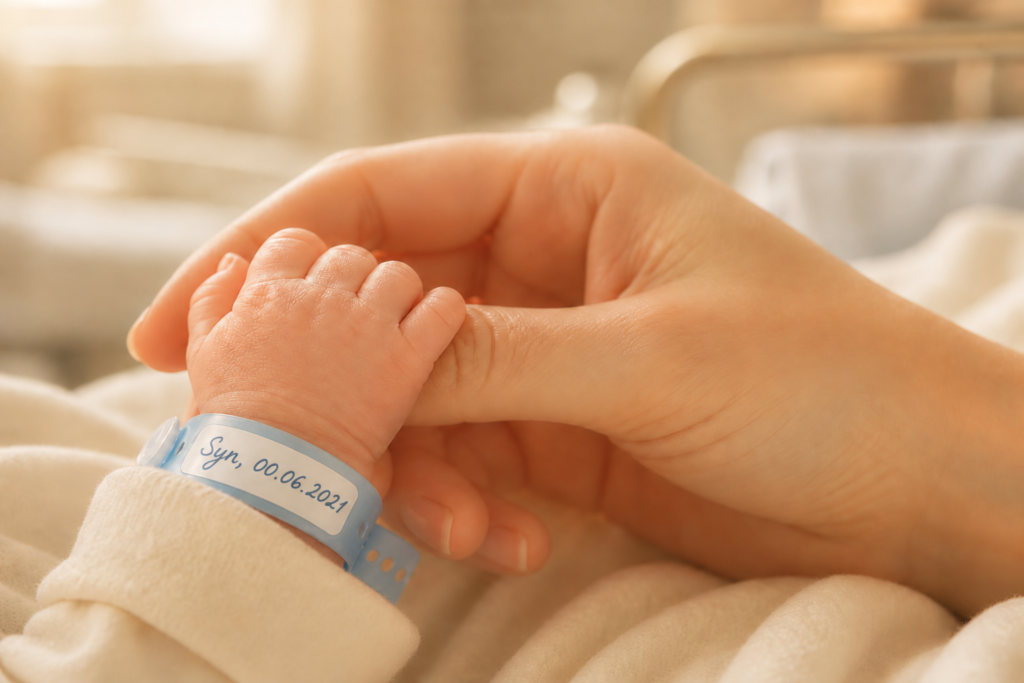
- 14:45 — Met my first son
- 15:00 — Surgery completed
Somehow, the whole thing was over in just 30 minutes. After all the pain and anxiety I had gone through during those days in the hospital, the moment felt almost strangely anticlimactic. But more than anything, I was grateful.
The medical staff showed me the baby and said,“Here, this is your baby.” I was completely dazed. It felt strange to think that this tiny person had been inside my belly just moments ago and was suddenly outside.
“What am I supposed to do?” I asked.
The medical staff kindly told me,
“Say hello to your baby and give him three kisses. Then we’ll check to make sure he’s healthy.”
5. After the Brief Joy of Meeting My Son, the Real Challenge Began
I was moved to the recovery room. Once I had a moment to process what had just happened, my baby was brought to me after his initial checkup. I was still lying there, unable to move my lower body because of the anesthesia, when a nurse placed him on my chest for skin-to-skin contact. After a while, the nurses took him away to change his diaper and put him in his crib, telling me to get some rest.
But then, at some point, the anesthesia began to wear off. An indescribably intense pain suddenly hit me. It hurt so badly that I could barely speak. I remember thinking,
“Is this what it feels like to get shot in the stomach?”
I called the nurse and told her how much pain I was in. She explained that I had already been given acetaminophen and that morphine could be given if necessary. I practically begged her to give me anything stronger. It wasn’t until I received stronger pain medication that I could finally calm down.
After seven hours in the recovery room, I had to be moved to the regular ward. I was given the choice of walking there or using a wheelchair. When I was told that walking as soon as possible was one of the best ways to help prevent postoperative adhesions, I somehow squeezed every last bit of strength out of myself and started walking.
The regular ward was a shared room, and, unfortunately, I happened to give birth during one of the hottest summers of the year. Maybe it was the adrenaline still pumping through my body after the bleeding and emergency C-section, but I couldn’t sleep at all. I breastfed whenever the baby wanted, throughout the night.At some point in the early morning, a nurse came in and kindly told me she would hold the baby for a while so I could get some sleep. That simple gesture meant so much to me.
The next morning, the nurse was checking on the mothers and babies when she suddenly looked puzzled. It turned out that I hadn’t changed my baby’s diaper even once during the entire night. I had completely forgotten. Thankfully, the nurse kindly taught me one of the most basic rules of newborn care: Every two to three hours, when it’s time to feed the baby, check the diaper first and change it if necessary.
6. The Heartbreak of Delayed Discharge and the 3-Hour Feeding Loop
Sadly, my milk supply was slow to come in after the C-section. After three days, my baby’s weight had dropped by 10%, so the hospital recommended extending our stay and supplementing with formula. I had gone through all of this alone in a Polish hospital where I could barely communicate with anyone, without my husband by my side. So I had been desperately counting down the days until I could go home.
When I was told that I couldn’t leave that day, I was so upset that I cried like a child. The doctor gave me some time to calm down, and then a nurse came back and explained the situation to me. She told me that if I really wanted to go home, I could sign a declaration taking responsibility for my baby’s health and leave the hospital. Of course, my baby’s health came first. So I pulled myself together and decided that even if our discharge was delayed, I would stay until I felt confident that my baby was healthy enough to go home. Thankfully, once we started supplementing with formula, my baby quickly began gaining weight.
Once discharged, life shifted into full ‘zombie mode.’ The cycle was relentless: Nursing (30m) → Pumping (30m) → Diaper Change → Washing Pump Parts → Repeat in 3 hours.
Following the Polish healthcare system, I contacted our designated clinic (Przychodnia) and asked if a postpartum midwife could come to our home as soon as possible. The midwife understood that the situation was urgent and arranged visits every two to three days. Since my baby’s weight gain was our biggest concern, she brought a newborn scale and weighed him at every visit.
Thankfully, after about a week, she confirmed that my baby’s weight was increasing at roughly twice the average rate. Only then could I finally relax. After about a month of intense supplementation, I eventually succeeded in exclusively breastfeeding.
It was an endless cycle of breastfeeding and pumping. I also needed to eat, shower, and sleep… And I can’t tell you how much I resented that feeding alarm going off every three hours.
Ironically, one good thing that came out of the pandemic was that my husband was able to work from home. In between meetings and work, he made sure I had something to eat. While I was breastfeeding, he would even put food into my mouth for me. At night, worried that I might get hungry or thirsty, he would cut up a watermelon and keep it in the refrigerator for me. Looking back, I honestly wonder if either of us got a proper night’s sleep during that entire month.
And just like that, in the middle of all the chaos, our life as parents of our first child began. And at the time, I had no idea. I didn’t know this was only the beginning of the long journey of raising three children.
I’ll continue with our second child’s story in the next episode. Stay tuned for Part 2, where I’ll share the story of my second baby!
![[Home Baking] Polish Crepes, Naleśniki | A Korean-Polish Family’s Kids Snack](https://seminalife.com/wp-content/uploads/2026/09/Nalesniki-recipe-photo-1024x765.png)