A few days ago, I took my third child to get vaccinated.
In Poland, children’s vaccinations are usually given at a pediatrician’s office or clinic within the POZ (Podstawowa Opieka Zdrowotna, primary healthcare) system. If you search for “Przychodnia” in your local area, you can easily find these primary healthcare clinics.
This time, my third child received two vaccines. One was Bexsero, which protects against group B meningococcal disease, and the other was Nimenrix, which protects against meningococcal groups A, C, W, and Y. Both are recommended vaccines for healthy children in Poland, but they are not included in the standard national free mandatory vaccination program, so we paid for them ourselves. Since we had both vaccines done on the same day, the total came to more than 600 PLN.
I didn’t originally plan on writing this post. On the day of my child’s vaccination, I ended up talking about childhood vaccines with some university friends who are raising their children in different European countries.
“Are the vaccination schedules different between Korea and Europe?”
“If my child started a vaccination in Korea, can we continue it in Europe?”
“This vaccine is free in Korea. Do we have to pay for it here?”
As we talked, I realized that vaccination systems can vary quite a bit from one European country to another. For families like ours, who move between Korea and Poland while raising children, managing vaccination schedules requires a little more planning.
Especially when a child is receiving a vaccine that requires multiple doses and booster shots, it is really important to check in advance which country the next dose will be given in.
So I decided to compare the vaccination systems in the two countries based on the National Immunization Program (NIP) of the Korea Disease Control and Prevention Agency (KDCA), Poland’s Program Szczepień Ochronnych (PSO), and vaccination information published by NIZP PZH.
1. How Are the Vaccination Systems in Korea and Poland Different?
First, even the terminology is a little different.
In Korea, the term NIP (National Immunization Program) is used, while in Poland the national vaccination program is called PSO (Program Szczepień Ochronnych, Protective Vaccination Program).
The Polish PSO is broadly divided into obowiązkowe (mandatory) and zalecane (recommended) vaccinations. Korea also has legally designated vaccine-preventable diseases for which vaccination is required, and vaccines included in the National Immunization Program are covered by the government.
- Korea (NIP): The National Immunization Program includes vaccines against tuberculosis, hepatitis B, diphtheria, tetanus, pertussis, polio, measles, mumps and rubella (MMR), chickenpox, Japanese encephalitis, Hib, pneumococcal disease, hepatitis A, rotavirus, HPV, influenza, and others.
- Poland (PSO): BCG, hepatitis B, DTP, IPV, Hib, pneumococcal, rotavirus, and MMR vaccinations are included among the mandatory and free vaccinations. Meningococcal vaccines, hepatitis A, TBE, and routine chickenpox vaccination are generally classified as recommended vaccinations. However, some vaccines, such as chickenpox, can become mandatory and free for certain high-risk groups or under specific conditions, including attendance at certain childcare facilities.
So rather than simply saying “vaccines are free in Korea but paid in Poland,” it is more accurate to look at which vaccines are mandatory, which are recommended, and which recommended vaccines may still be free or reimbursed under certain conditions.
📌 The information in this post is based on information checked as of September 2026.
Korea vs. Poland: Vaccination at a Glance
| Vaccine | 🇰🇷 Korea (NIP) | 🇵🇱 Poland (PSO) | Key Difference / Point |
|---|---|---|---|
| BCG (Tuberculosis) | National Program · Free | Mandatory · Free | Both countries vaccinate shortly after birth |
| Hepatitis B | National Program · Free | Mandatory · Free | Part of the routine infant schedule in both countries |
| DTaP/IPV/Hib | National Program · Free | Mandatory · Free | Part of the routine infant schedule in both countries |
| 6-in-1 vaccine | National Program · Free(5-in-1 + separate hepatitis B vaccination is also possible) | Generally a paid option | With the free basic vaccines, the components may be given separately |
| Pneumococcal | National Program · Free | Mandatory · Free | Routine vaccination in both countries |
| Rotavirus | National Program · Free | Mandatory · Free | Routine vaccination in both countries |
| MMR | National Program · Free | Mandatory · Free | Routine vaccination in both countries |
| Chickenpox (Varicella) | National Program · Free | Recommended and paid for healthy children / Free under certain conditions | Difference: Free vaccination may apply to children attending certain childcare facilities |
| Hepatitis A | National Program · Free | Recommended · Paid | Difference |
| Japanese encephalitis | National Program · Free | Not part of the routine schedule | Difference: Routine vaccination in Korea, not in Poland |
| TBE (Tick-borne encephalitis) | Not included | Recommended · Paid | Difference: Recommended vaccination in Poland |
| Meningococcal B | Not mandatory (self-paid) | Recommended · Paid | Bexsero and other MenB vaccines |
| Meningococcal ACWY | Not mandatory (self-paid) | Recommended · Paid | Nimenrix and other MenACWY vaccines |
| Influenza | National Program · Free | Recommended · Free/reimbursement programs | Both countries provide free or supported vaccination programs for children |
| HPV | National Program · Free (free vaccination for 12-year-old boys added in May 2026) | Recommended · Free (girls and boys aged 9 to under 14) | Both countries have expanded support for adolescent vaccination |
2. The Most Noticeable Differences — Chickenpox and Hepatitis A
These were probably the two things that surprised me most when I first looked at the Polish vaccination schedule.
In Korea, the National Immunization Program includes one chickenpox dose at 12–15 months and two hepatitis A doses between 12 and 35 months.
Chickenpox
Chickenpox vaccination is a little more complicated in Poland.
For generally healthy children, it is recommended and usually paid for, but children in certain high-risk groups or children attending certain childcare facilities, such as a żłobek (nursery/daycare) or klub dziecięcy (children’s club), may qualify for free mandatory vaccination under specific conditions.
Another important difference is the number of doses. In Korea, one dose is the standard NIP schedule, whereas in Poland, the general recommended schedule calls for two doses.
That does not mean that a child who received one chickenpox vaccination in Korea automatically needs another dose in Poland. The local healthcare provider should determine whether any additional dose is needed based on the child’s vaccination history and age.
Hepatitis A
Hepatitis A is another major difference.
In Korea, it is included in the National Immunization Program, whereas in Poland it is classified as a recommended, paid vaccination.
For families raising children between Korea and Poland, this means it is worth deciding in advance where and when to complete the hepatitis A vaccination series.
3. Korea’s Routine Japanese Encephalitis Vaccination vs. Poland’s Recommended TBE Vaccination
This is one of the clearest examples of how the two countries’ vaccination policies reflect differences in infectious disease patterns and public health policy.
Japanese Encephalitis
In Korea, Japanese encephalitis vaccination is part of the National Immunization Program beginning after 12 months of age.
In contrast, the Polish PSO does not include routine Japanese encephalitis vaccination for children.
If a child was born in Poland and raised there but will spend the summer in Korea or live in Korea for an extended period, it is a good idea to ask a Korean healthcare provider whether Japanese encephalitis vaccination is appropriate based on the child’s travel or residence plans and previous vaccination history.
Tick-borne Encephalitis (TBE / KZM)
On the other hand, TBE may be less familiar to families in Korea, but in Poland, TBE (kleszczowe zapalenie mózgu / tick-borne encephalitis) is included among recommended vaccinations.
It is particularly relevant for children who spend time in areas where ticks are present, such as forests and grassy outdoor areas.
TBE vaccination is a recommended vaccination, not a routine mandatory and universally free vaccination.
4. Poland’s 6-in-1 Vaccine — How Is It Different from Korea?
A 6-in-1 vaccine combines protection against:
- DTaP — diphtheria, tetanus and pertussis
- IPV — polio
- Hib — Haemophilus influenzae type b
- HepB — hepatitis B
into a single combination vaccine.
In other words, “6-in-1” means that the vaccine contains protection against six antigens in one injection. It does not mean that one injection completes the entire vaccination series.
Korea
In Korea, 6-in-1 combination vaccines such as Hexaxim have been introduced into the National Immunization Program and are provided free of charge to eligible infants.
It is also possible to use the previously supported combination of a 5-in-1 vaccine plus a separate hepatitis B vaccination, which is also covered.
Poland
With the free basic vaccines in Poland, the vaccinations may be given in several separate injections. Parents who want to reduce the number of injections can choose a 6-in-1 vaccine, such as Hexyon/Hexacima or Infanrix Hexa, but generally have to pay for it themselves. Certain high-risk groups, such as premature infants, may qualify for free vaccination.
In our family, all three of our children received the 6-in-1 vaccine at our own expense.
We decided that reducing the number of injections would be more comfortable for both the children and us as parents.
Of course, choosing the free basic vaccines does not mean that they are less effective. The main differences between the basic and combination options are the vaccine composition, number of injections, and cost.
5. Bexsero and Nimenrix — What You Should Know About These Meningococcal Vaccines
Since my child received meningococcal vaccines today, I also wanted to clear up a few facts.
“Bexsero always requires three doses.” — ❌ Not necessarily
The schedule depends on the age at which vaccination is started.
According to NIZP PZH information in Poland:
- If vaccination starts at 2–5 months, a 2+1 or 3+1 schedule may be used — two or three primary doses followed by a booster.
- If vaccination starts at 6–11 months or 12–23 months, the schedule consists of two primary doses plus a booster.
- From 2 years of age, the schedule is generally two doses.
So it is not simply “three doses no matter what.” You need to consider the age at the first dose, how many doses have already been given, and the minimum interval required before the next dose.
“If my child received Bexsero, why would they also need Nimenrix?”
Because the two vaccines protect against different meningococcal serogroups:
- Bexsero → Group B
- Nimenrix → Groups A, C, W and Y
They do not simply duplicate each other. They target different serogroups, which is why both may be recommended.
However, it is important to remember that these two vaccines do not provide complete protection against every possible meningococcal infection.
6. Can You Continue Vaccinations After Moving to Another Country?
This is actually the main reason I decided to write this post.
The short answer is: moving to another country does not mean that you have to start your child’s vaccination schedule all over again.
Both Korean vaccination guidance and the Polish PSO provide for completing vaccinations based on previous vaccination records when doses have been delayed or interrupted.
The local healthcare provider will review the child’s existing records and determine the remaining schedule based on factors such as:
- the child’s age
- previous vaccination dates
- the vaccine product
- the number of doses already received
- minimum intervals between doses
Be careful when switching vaccine brands
The rules are different for different vaccines.
For combination vaccines such as DTaP, and for vaccines such as Bexsero, it is preferable to complete the primary series with the same manufacturer’s product when possible. Korean KDCA guidance, for example, specifies the use of the same manufacturer for the primary DTaP series.
If the same product is difficult to obtain locally, the doctor will determine whether another product can be used based on the vaccine type and its components.
For example, Trumenba, another MenB vaccine available in Poland, is intended for people aged 10 and older, so it cannot simply replace Bexsero for an infant.
So, in my opinion, the safest approach is:
① Check the previous vaccination records → ② Identify the exact product → ③ Confirm the vaccination date and dose number → ④ Have a local healthcare professional determine whether and when the next dose can be given.
7. What’s New in 2026 — HPV and Influenza Vaccination
HPV
One of the important changes in Korea in 2026 was the expansion of national HPV vaccination support to boys.
Starting May 6, 2026, Korea began providing free HPV quadrivalent vaccination to boys born in 2014, who are 12 years old in 2026.
So rather than saying that “all 12-year-old boys are automatically covered,” it is more accurate to say that the program began in 2026 with boys born in 2014.
In Poland, free HPV vaccination is available to girls and boys aged 9 to under 14 under the current program.
Influenza
Both countries also operate national influenza vaccination support programs, but these should be distinguished from legally mandatory routine vaccinations.
In Korea, the eligible age for the children’s national influenza vaccination program was expanded in 2026 to include children from 6 months through 14 years of age.
Poland also operates reimbursement and/or free vaccination programs for children’s influenza vaccination, although the exact eligibility and method of coverage can vary depending on age and other conditions.
📌 Vaccination Checklist for Families Moving Between Korea and Poland
[Before Leaving Korea]
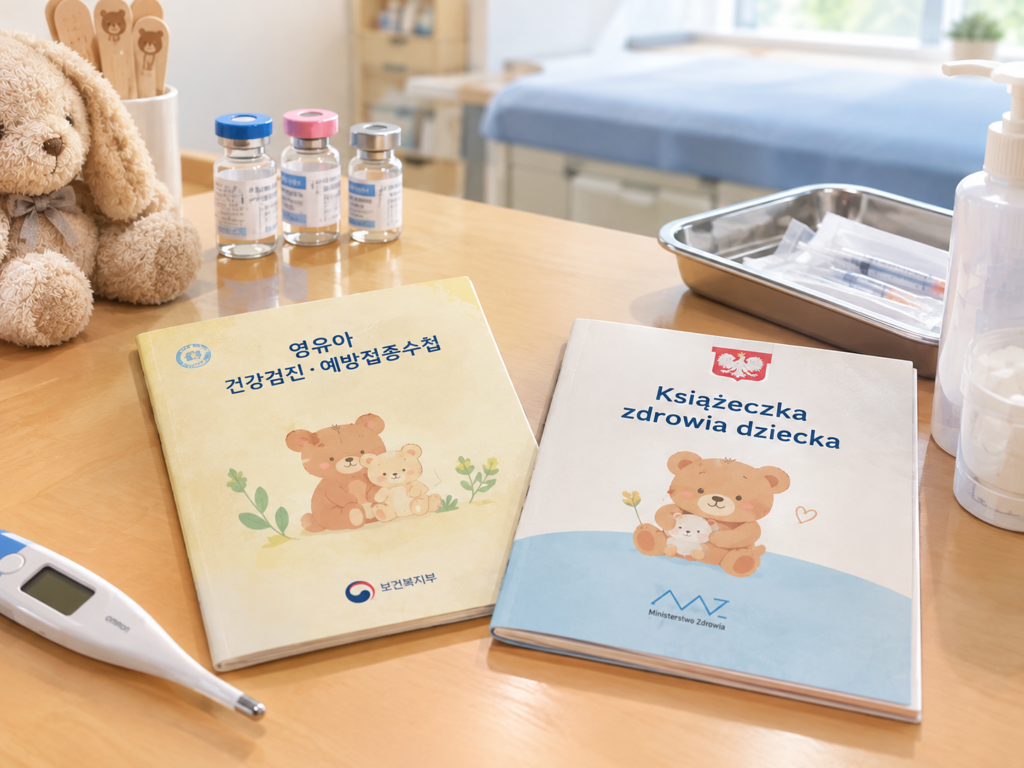
- Print your child’s vaccination record from the Korean National Immunization Registry / Vaccination Assistant (예방접종도우미)
- Bring the child’s Polish vaccination record, Karta Uodpornienia
- Check the date of the next scheduled vaccination
- Check the minimum interval between the last and next doses
- Write down the exact vaccine product name and manufacturer
[A Useful Way to Record Vaccinations]
Rather than writing down just the vaccine name, it is much more helpful to record “vaccine name + product name + date + dose number.”
(Example: Bexsero / GSK / Dose 1 / June 15, 2026)
Final Thoughts
This post started with my own experience taking my third child to get Bexsero and Nimenrix.
After comparing the vaccination information from both countries, I realized there was much more to learn than I had expected.
Every country has different infectious disease patterns, public health policies, and systems for funding vaccinations, but I also learned that the overall framework of routine childhood vaccination in Korea and Poland is quite similar.
At the same time, the same vaccine can differ from country to country in terms of whether it is free or paid, mandatory or recommended, how many doses are required, and which products are available.
Especially for vaccines that require multiple doses to complete a series, I was reminded once again how important it is to keep good records of which vaccine was given, which product was used, and when each dose was administered.
Managing vaccination records according to two different countries while raising three children is not always easy.
But once I started organizing everything step by step, I felt much more reassured.
I hope this post will also be useful to other international families raising children in Poland or elsewhere abroad!
🔗 Official Vaccination Resources from Korea and Poland
- Korea Disease Control and Prevention Agency (KDCA) — National Immunization Registry / Vaccination Assistant:
https://nip.kdca.go.kr - Korea Disease Control and Prevention Agency — 2026 National Immunization Program Guidelines:
https://www.kdca.go.kr/kdca/2861/subview.do?enc=Zm5jdDF8QEB8JTJGYmJzJTJGa2RjYSUyRjU1JTJGMzA5NjgzJTJGYXJ0Y2xWaWV3LmRvJTNGcGFzc3dvcmQlM0QlMjZyZ3NCZ25kZVN0ciUzRCUyNmZpbmRPcG53cmQlM0QlMjZyZ3NFbmRkZVN0ciUzRCUyNmZpbmRUeXBlJTNEJTI2ZmluZENsU2Vx - Poland — 2026 Program Szczepień Ochronnych (PSO):
https://www.gov.pl/web/gis/program-szczepien-ochronnych-na-2026-rok - Polish Chief Sanitary Inspectorate (GIS):
https://www.gov.pl/web/gis - Polish National Institute of Public Health (NIZP PZH) — Vaccination Portal:
https://szczepienia.pzh.gov.pl - pacjent.gov.pl — 2026 Childhood and Adolescent Vaccination Schedule:
https://pacjent.gov.pl/kalendarz-szczepien-dzieci-i-mlodziezy-na-2026-rok
※ This post is a personal parenting record based on publicly available information from the Korean Disease Control and Prevention Agency (KDCA), the Polish government and GIS, NIZP PZH, and other official sources, checked as of September 2026. Vaccination schedules, costs, and eligibility for government support may vary depending on a child’s age, health status, vaccination history, and changes in national policy. Please consult your child’s healthcare provider before receiving any vaccination.