
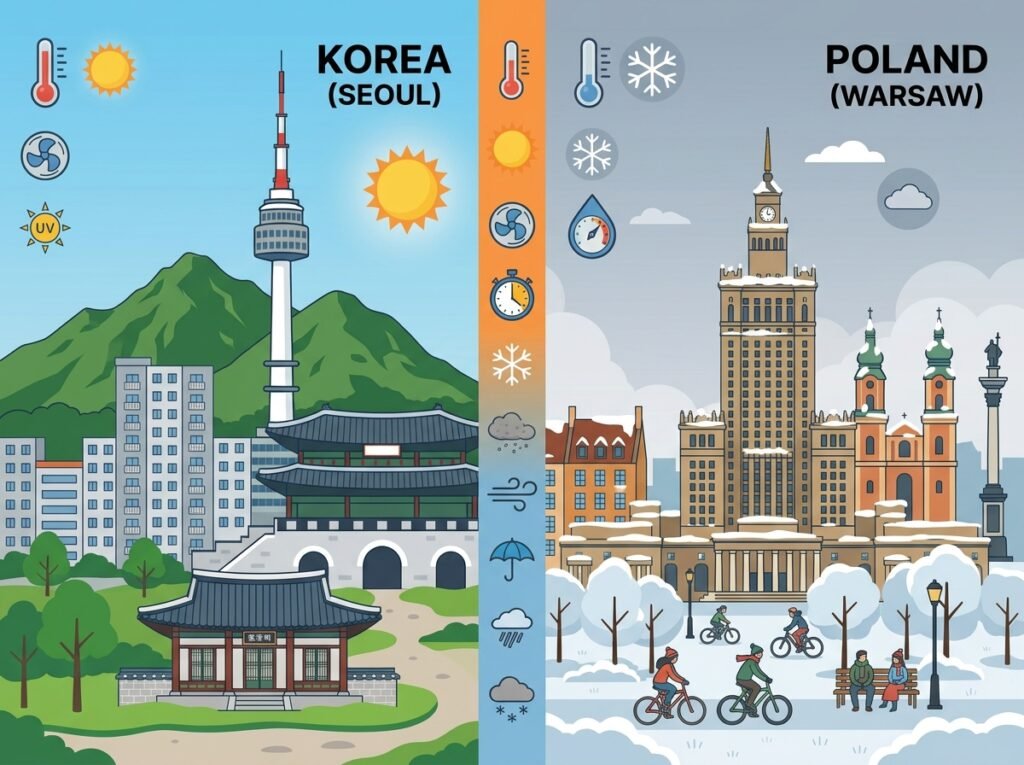
One of the questions I hear most often from people preparing to move to Poland is about the weather.
“Is Poland really that cold?”
“When does it start getting warm?”
“Is Poland a nice place to live in summer?”
Before moving to Poland, I imagined Polish winters would be extremely cold and long. When Koreans picture winter in Poland, there is often an image of heavy snowfall, temperatures staying below freezing all day, and having to wear a thick down jacket for several months.
But after actually living here, I realized that Poland is certainly cold, but the cold feels quite different from Korea’s. And as I’ve lived here, I’ve realized that the biggest differences aren’t just about temperature. Humidity, daylight hours, the amount of rain and snow, wind, summers with no heavy humidity, and winter air quality all make a significant difference.
So today, based on both my own experiences and actual weather data, I’m going to compare the climate of South Korea (using Seoul as a reference) and Poland (using Warsaw as a reference) in detail.
1. The Big Picture: The Climate Types Are Different
South Korea has a temperate monsoon climate with four distinct seasons. Summers are hot and humid, while winters are cold and dry. Korea also has two very distinctive seasonal “events”: the monsoon season and typhoons.
Warsaw, Poland, has a climate somewhere between an oceanic and a continental climate. The difference between summer and winter temperatures is similar to, or slightly smaller than, that of Seoul. But the biggest differences are humidity and precipitation patterns. Poland does not have a rainy season with several weeks of concentrated rainfall as Korea does. Instead, rain is spread more evenly throughout the year, with plenty of cloudy and rainy days.
If I had to describe it, Poland feels less like a place with four sharply defined seasons and more like a place with long, subtle transition periods between seasons.
2. Seasonal Temperature Comparison
Here are the average monthly high and low temperatures for Warsaw compared with Seoul.
| Time of Year | Warsaw (°C) | Seoul (°C) | What It Feels Like & Practical Tips |
|---|---|---|---|
| January (mid-winter) | High -1 to 0 / Low -7 to -4 | High 1 to 2 / Low -8 to -6 | Similar minimum temperatures, but Warsaw often feels gloomy and dreary because of the cloudy weather |
| March (early spring) | High 4 to 8 / Low 0 to 1 | High 9 to 10 / Low -1 to 0 | Spring in name only—you’ll still need a winter coat or down jacket |
| May (proper spring) | High 19 / Low 9 | High 21 / Low 11 | Daylight increases rapidly, and outdoor activities really begin |
| July (mid-summer) | High 24 to 25 / Low 14 to 15 | High 29 to 31 / Low 22 to 23 | Much less humid and generally comfortable; it can feel pleasantly cool in the shade |
| October (autumn) | High 13 / Low 7 | High 18 to 19 / Low 9 to 10 | Autumn is relatively short and the weather quickly turns chilly |
| December (early winter) | High 3 / Low -1 | High 6 to 7 / Low -2 to -3 | Daylight disappears rapidly, with frequent sleet and rain |
When does it start getting warm? In my experience, around late April to early May. March may technically be spring, but you’ll still need a proper coat. From May through August, however, the weather can be absolutely lovely. And once the very long summer evenings begin around June, you really start to understand the charm of summer in Poland.
3. Humidity: The Real Reason Polish Summers Are So Comfortable
One of the things that surprises Koreans the most when they experience summer in Poland is the humidity. Summer humidity in Seoul often reaches 70–80% or more, creating that familiar hot and sticky feeling. In Warsaw, humidity is generally much lower. Even when temperatures approach 30°C, it can feel much more bearable in the shade, and a breeze can even make it feel pleasantly cool.
Winter is a different story. Humidity can actually be fairly high, and the cold can sometimes feel like it sinks right into your bones.
The key takeaway is: the temperature may look similar on paper, but it can feel completely different.
In Polish apartments, radiators and central heating can make the indoor air extremely dry, so a humidifier is practically essential. In some residential areas and outlying regions, individual heating systems using coal or wood are still common, which can contribute to both dry indoor air and winter smog. For families with young children or people who are sensitive to dry air or respiratory irritants, I highly recommend having a humidifier at home. One thing you’ll definitely notice compared with Korea is how quickly laundry dries indoors during winter.
Recently, perhaps because of climate change, it also feels as though hot and humid summer days are becoming more common every year. In the past, heat waves usually lasted about a week, so many households simply thought, “Let’s get through this one week,” and managed without air conditioning. But as hot spells and warm nights have become longer, demand for air conditioning has been increasing rapidly in Poland as well.
4. Daylight Hours: Bright at 10 PM in Summer, Dark by 4 PM in Winter
This is still one of the hardest things for me to get used to. And as a parent, it can be surprisingly inconvenient too.
- Summer (around the June solstice): In Warsaw, sunrise is around 4:30 a.m. and sunset is after 9 p.m. With roughly 16–17 hours of daylight, it can still feel like daytime at 8 p.m. Blackout curtains are practically essential when putting children to bed. Some children may also wake up earlier because it gets light so early. And because it is still bright after dinner, children may not feel like going to bed at all.
- Winter (around the December solstice): The opposite happens. Sunrise is around 7:45 a.m., while sunset is between about 3:30 and 4 p.m. That means there are fewer than eight hours of daylight. By 4 p.m., it already feels like nighttime, making the whole day seem incredibly short. You can experience the strange feeling of leaving for work in the dark and coming home in the dark as well. The short winter days can also affect people’s mood, and some people experience seasonal depression, the winter blues, or Seasonal Affective Disorder (SAD). For families with children, it can also be difficult to fit outdoor activities in after school.
South Korea also has noticeable seasonal changes in daylight hours, but the difference is much more extreme in Poland. This is something worth preparing yourself for, especially if you have children, because it can actually affect daily routines, including nap times and bedtime.
5. UV Exposure: Don’t Let Your Guard Down in Summer, and Consider Vitamin D in Winter
Because Poland is located at a higher latitude than South Korea, the sun sits much lower in the sky during winter and UV levels are also lower. Interestingly, despite Poland’s higher latitude, the UV Index can still reach 6–7 on many days in June and July, meaning sun protection is just as important as it is during a Korean summer. The exceptionally long summer days also mean that you can be exposed to sunlight for longer periods.
Winter has a different problem. From November to February, the sun stays low in the sky and cloudy days are common, so UV exposure can be very limited. Since this makes it difficult for the body to produce enough vitamin D from sunlight, many people in Poland take vitamin D supplements during the winter. Even at routine child check-ups, doctors often ask parents whether their children are taking vitamin D.
6. Rainfall: No Monsoon Season, but Plenty of Cloudy Days
South Korea has a very distinct rainy season, with a large portion of its annual rainfall concentrated between late June and late July.
Poland does not have this kind of monsoon season. Instead, precipitation is relatively evenly distributed throughout the year. July tends to be one of the wetter months, with around 90 mm of rainfall, but rain often comes in the form of short, heavy showers rather than lasting all day. The total annual rainfall is also much lower than in Seoul: Seoul receives around 1,300–1,500 mm of rain per year, compared with roughly 500–550 mm in Warsaw.
However, Poland has quite a lot of rainy or cloudy days spread throughout the year, which can make it feel as though the sky is overcast surprisingly often. That is one reason I find a waterproof jacket or hoodie more useful than carrying an umbrella everywhere.
Every year is different, but snow can be fairly frequent in winter and occasionally accumulate quite deeply. A good pair of warm, waterproof winter boots can therefore be very useful. And when it snows heavily, there is actually a fun side to it. The snow makes those dark winter days feel a little brighter, and you may even see children being taken to and from school on sleds. Those are some of the little things I’ve come to enjoy about winter in Poland.
7. Wind and Typhoons: One Less Thing to Worry About
Here’s some good news. Poland is a landlocked country and is completely outside the influence of tropical cyclones such as the typhoons that affect Korea. So you don’t need to prepare for typhoons in summer and autumn the way you would in Korea.
Instead, Poland occasionally experiences strong low-pressure systems and extratropical storms coming from the Atlantic, particularly in late autumn and winter. These can sometimes bring strong winds and weather warnings. They are generally not as destructive as a typhoon, but the wind can still become surprisingly strong, so it’s a good habit to check the wind forecast before going outside in winter. As in Korea, you will usually receive weather alerts on your phone when conditions are severe. During particularly strong winds, trees can break or signs and other objects can be blown around, occasionally causing accidents. So some caution is still necessary. Wind can also make a significant difference to how cold it feels. In winter, I recommend checking the feels-like temperature as well as the actual temperature when deciding what to wear.
8. Air Quality: Neither Country Is Perfect, but the Timing Is Different
This is something I especially want to point out because it may not be obvious to people from Korea.
- Seoul: Annual average PM2.5 concentrations are more than three times the World Health Organization (WHO) guideline level. Air quality often gets worse in spring (March–May) due to yellow dust and fine dust carried from mainland Asia.
- Warsaw: On an annual average, air quality can be similar to or somewhat better than Seoul, but it can become significantly worse during winter (November–February). One reason is that some households, particularly outside major cities, still rely on individual heating systems that burn coal or wood. Air quality in Poland has generally been improving under European Union regulations, but rising heating costs following the war in Ukraine have made the situation more complicated, and it has sometimes felt as though more people have turned to coal or wood for heating. Polish cities, particularly in the south—including Kraków—frequently rank among the European cities with the highest levels of air pollution. Warsaw can also experience winter PM2.5 levels more than twice as high as those seen during summer on some days.
So, in simple terms: in Korea, pay more attention to air quality in spring; in Poland, pay more attention in winter. If you’re planning to move to Poland, I recommend getting into the habit of checking an air-quality app during winter and considering an air purifier for your home, just as you might in Seoul.
9. Practical Tips for Anyone Coming to Poland
- If you’re planning a trip: I recommend visiting between May and September. July and August are especially good for travel, with plenty of opportunities for outdoor activities such as visiting lakes, the seaside, parks, and campsites.
- Layer your clothes in spring and autumn: Temperatures can change significantly throughout the day, and the weather can shift suddenly. I recommend wearing several layers—a T-shirt, cardigan, jacket, scarf, and so on—so you can adjust easily.
- Don’t forget sun protection in summer: The cooler temperatures can be deceptive. You can still get sunburned, so bring sunscreen and sunglasses.
- Blackout curtains are a summer essential: With the sun staying up until around 9–10 p.m., blackout curtains can make a huge difference when you’re trying to get children to sleep.
- For winter clothing, prioritize waterproof and windproof features: Humid cold and wind can make it feel much colder than the actual temperature suggests. Personally, I prefer one good, warm coat that blocks snow, rain, and wind over several thin layers of thermal clothing. A warm hat, gloves, scarf, and waterproof winter boots are also worth having.
- Vitamin D is an important winter consideration: Especially if you have children, ask your pediatrician about vitamin D supplementation during the winter months.
- Keep an eye on air quality in winter: Think of winter in Poland as the equivalent of spring in Korea when it comes to checking air pollution.
- Use reflectors for winter visibility: It gets dark as early as 4 p.m. in winter, so consider adding reflective stickers or reflectors (odblaski) to your stroller, your children’s school bags, and winter coats. Choosing brighter-colored clothing instead of dark colors can also improve visibility.
So, Is Poland Really That Cold?
Polish weather isn’t necessarily extremely harsh. I would describe it more as weather with a different rhythm from what you may be used to in Korea. It took me about a year to fully adjust. Now, perhaps because my body has finally adapted, I’ve grown to love the dry, comfortable summers—and even the winters, when heavy snowfall means we can sometimes go sledding on the way to school.
So if you’re preparing to move to Poland, don’t just pack for the cold. Think about the light, humidity, wind, rain, snow, and seasonal rhythm as well. Those differences are what really shape everyday life here.