Raising children in Poland, I sometimes need a little time for myself. But it’s not always easy to go out and leave the kids behind, and signing up for expensive private classes every time can add up quickly.
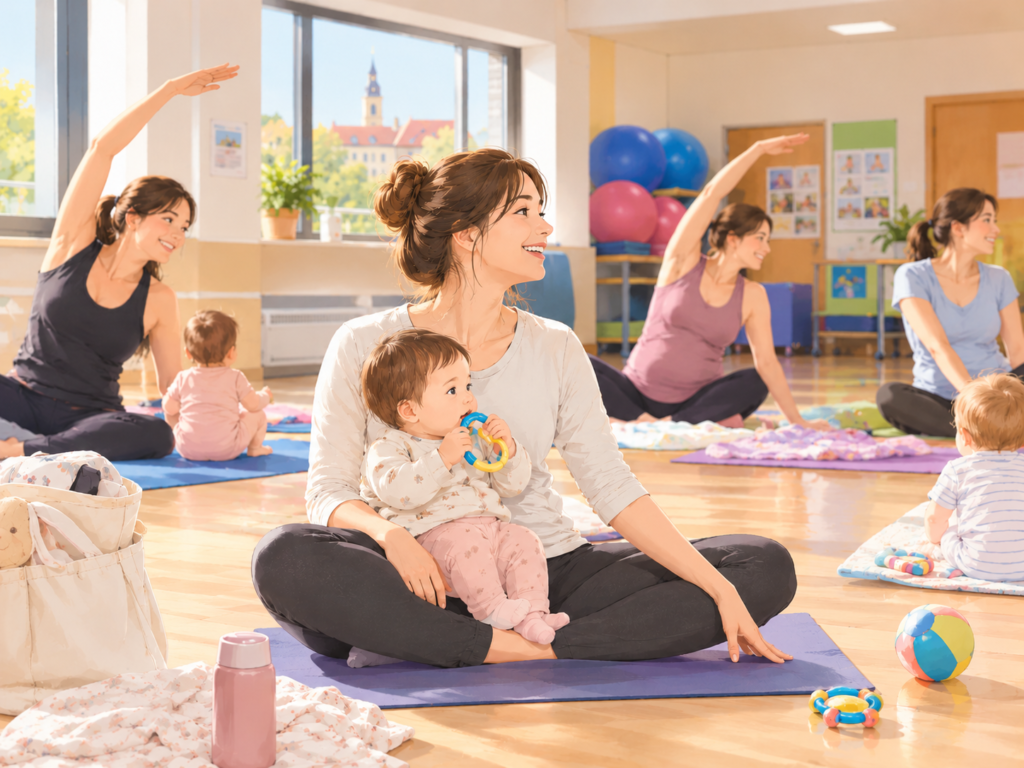
That’s why I’d love to recommend Dom Kultury, Poland’s local cultural centers. They offer great value for money, and you can often find one close to home. Best of all, some classes even allow you to bring your baby along! (For instance, my 1-hour prenatal/postnatal exercise class costs just 120 PLN/month for once a week, 180 PLN/month for twice a week, or 240 PLN/month for three times a week—far more affordable than private gyms!)
I still attend prenatal and postnatal fitness classes, and my eldest child used to take dance classes there. These centers are a great resource whether you’re looking for activities for your children or simply want to get out of the house and do something for yourself. Our local cultural center even has a small cinema, so I sometimes take the kids there to watch a movie.
If you’re raising children in Poland, I highly recommend checking out your local cultural center!
1. How to Find a Cultural Center Near You?
The easiest way to start is to search for Dom Kultury on Google Maps.
Take a look at the cultural centers near your home, then visit their official websites to see what classes they offer and how to sign up.
Since each center runs different programs, it’s worth checking out several nearby locations rather than focusing on just one.
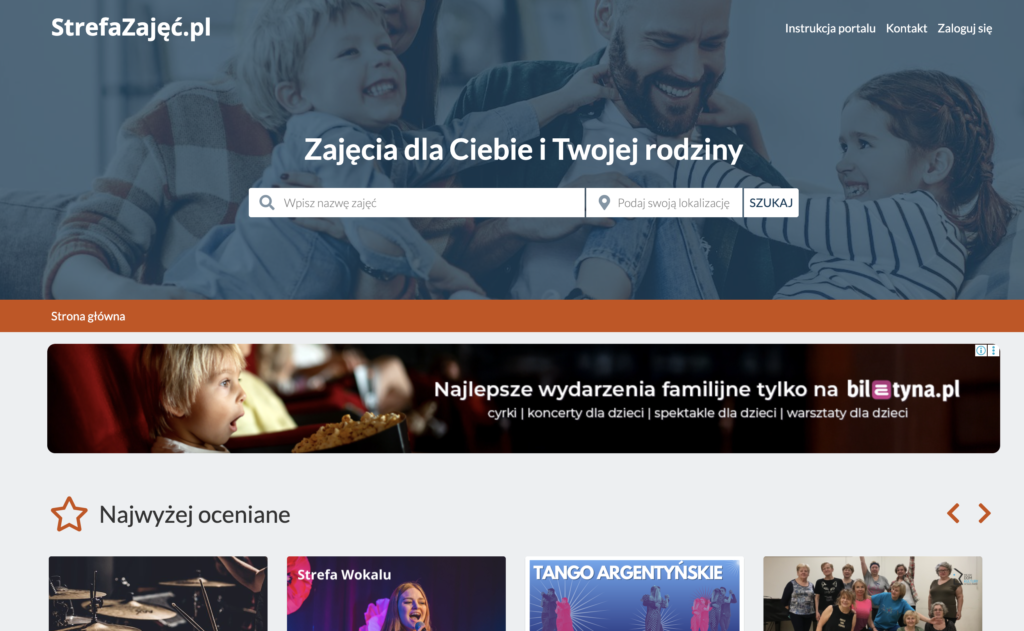
One particularly useful website for finding classes is Strefa Zajęć (strefazajec.pl). (Image below: the website’s homepage.)
This online platform allows you to search for and register for a wide range of classes offered by cultural centers and other educational institutions. Depending on the class, you may be able to check the schedule, location, fee, and number of available places.
Of course, not every cultural center uses this platform. If you can’t find a particular center or class there, be sure to check the center’s own website as well.
What Should You Search For?
When I was looking for prenatal and postnatal fitness classes, I tried search terms such as mama and dla mam (for moms).
You can also search using filters. If you’d rather start with the filters, simply leave the search field empty and click the “SZUKAJ” (SEARCH) button. A list of classes will appear, along with filter options in the left-hand sidebar.
- Miasto — City
- Organizator — Organizer (you can select a nearby cultural center you found on Google Maps)
- Typ — Type of activity (classes, workshops, online sessions, etc.)
- Kategoria — Category (music, art, fitness, etc.)
- Wiek — Age (enter the age as a number)
If you’re pregnant or have recently given birth, I also recommend looking for fitness classes designed for moms. One of my favorite things about prenatal and postnatal exercise classes is that you can bring your baby with you. For moms who don’t have anyone available to look after their little ones, this is a huge plus.
If you can communicate with the instructor, you can also ask questions about stretches for areas that feel sore or any other little concerns you might have. Since the other participants are also pregnant women or moms raising young children, it’s fun to chat and get to know one another, too.
If you have children, be sure to enter their ages to see which classes are available for them. My eldest child used to attend dance classes, and I’ve also seen plenty of children taking music lessons, pottery classes, and LEGO robotics. There’s such a wide variety of activities that even browsing through the options can be fun!
2. How Does Registration and Payment Work?
I’ll explain the process based on my experience with the cultural center I attend. Keep in mind that the procedures may vary from one center to another!
1) Find a class and register
Choose a class you’re interested in and submit your application. If the class runs several times a week, you may be able to choose your preferred day. However, submitting an application doesn’t necessarily mean your place is confirmed right away.
2) Wait for your application to be approved
At my local center, applications had to be reviewed and approved, depending on factors such as class capacity. Once approved, I received a notification by text message or email.
3) Make the payment
After my application was approved, the website allowed me to proceed with payment. At the center I attend, payment became available about one or two days before the class started. Since payment schedules can differ between institutions, be sure to check the notification you receive.
4) Tips for joining mid-month or starting the following month
If you register in the middle of the month, it’s a good idea to check how the start date and fees will be calculated.
At my center, even if I registered halfway through the month, the fee was adjusted to cover only the remaining classes from the time my application was approved, so I could start attending right away.
If you’d prefer to start the following month, you can leave a note in the comments section when registering. In my experience, the center accommodated my request and arranged the start date accordingly.
5) Check the class schedule
It’s always a good idea to double-check the schedule on the main page of the class you registered for.
If the instructor is sick or the schedule changes for another reason, the information may be updated on the class page, and you may also receive a text message.
I once made the trip to a class only to discover that it wasn’t taking place because I had relied on the original schedule. Since then, I’ve made a habit of checking my messages before heading out.
6) If you want to stop attending, make sure to cancel your registration
Your registration won’t necessarily be canceled automatically just because you stop attending.
At my center, I had to send an email or speak directly to the administrative office to let them know I wanted to withdraw. Otherwise, I could continue receiving payment reminders or messages about outstanding fees.
Be sure to check your center’s cancellation policy to find out whether refunds are available and when your cancellation will take effect.
3. What to Bring to Your First Class: A Few Helpful Tips
It’s surprisingly easy to get lost when visiting a new place for the first time. I still remember how I couldn’t find the classroom during my first session and had to ask the administrative office for help.
That’s why I recommend arriving a little early on your first visit.
- Find the classroom: It may take a while to find your way around the building, so give yourself plenty of time.
- Locate the toilets: If you’re bringing your baby, it’s especially helpful to check in advance whether there’s a changing table.
- Check whether you need indoor shoes or trainers: For fitness classes, find out whether you need indoor sports shoes or your own exercise mat. At my class, mats are provided and you can exercise in socks, but I prefer to bring a separate pair of indoor trainers for comfort. Don’t forget your water bottle!
- Find the administrative office: It’s useful to know where to go if you have questions or run into problems with your registration. If you have trouble communicating in Polish, a translation app can be a big help.
- A winter tip: Where to leave your coat and shoes (Szatnia): Many cultural centers in Poland have a designated cloakroom, called a szatnia, near the entrance, where visitors are generally expected to leave their coats and shoes. At the center I attend, there are coat hooks near the entrance to the class area. We take off our shoes before going in and hang up our coats, bringing only our bags and valuables into the room. If you have a special reason for needing to keep your coat with you, you can explain the situation and ask for permission. In my experience, there’s usually no need to worry too much.
In Polish, the administrative office is called biuro or sekretariat. If you see either of these words on a sign inside the building, it’s likely pointing you toward the office where you can ask for help.
Is It Okay If You Don’t Speak Polish Very Well?
Attending classes at a cultural center is a great way to get more exposure to Polish naturally.
Since I go mainly for exercise, I usually just exchange greetings and follow the instructor’s movements without needing to have much of a conversation.
Of course, I couldn’t understand every instruction when I first started. But after attending a few times, I began to recognize expressions that came up regularly during class.
Sometimes, when the instructor corrected my movements individually, they would explain things using a little English as well. Not every instructor speaks English, of course, but in my experience, you don’t need to put off getting started just because your Polish isn’t perfect.
The goal doesn’t have to be understanding everything or doing every exercise perfectly from day one. Simply showing up, moving your body, and gradually getting more comfortable is already worthwhile!
4. The Special Connections I’ve Made at My Local Cultural Center
After attending classes for a while, I started collecting some fun stories of my own. At first, it was simply somewhere I went to exercise. Before I knew it, the center had become part of my routine and a place where I could connect with people.
It Turned Out She Was My Husband’s Middle School Friend!
One day, a new expectant mom joined our class. I arrived a little early the following week, which gave us a chance to chat. She was very friendly and spoke English well, so we had an easy, comfortable conversation.
As we talked, I discovered something surprising: she lived in the same apartment complex as we did!
One particularly cold winter day, the roads were icy. Since she usually walked home, I offered to drive her. She told me it was fine because her parents lived just a few blocks from the cultural center.
Then I suddenly became curious.
“Did you grow up in this neighborhood, too?”
My husband was born and raised in this very area, and his parents still live here. To my surprise, she said she had grown up here as well!
On a hunch, I mentioned my husband’s name. And guess what? She was his friend from middle school!
We quickly became much closer and started visiting each other’s homes regularly. There’s a saying that a good neighbor can be better than a distant relative, and she has certainly proved that to be true. When I urgently needed a blood pressure monitor during pregnancy, she kindly brought one over for me.
(You can read more about this in My Childbirth Story in Poland, Part 3.)
After Having My Third Baby, I Started Exercising Again
After having my third baby, I wondered when I’d be able to start exercising again. Once I had settled into life with the new baby and given my body some time to recover, I decided that October would be the month I returned to class. I registered around the middle of September.
Then, just the following week, I received a message from the mom of one of my eldest child’s friends:
“You’re coming to exercise today, right?”
I was taken aback. How did she know I had signed up to start exercising again?
It turned out that the instructor checked the attendance list every day and had noticed my name newly added to it. She was happy to see me returning and mentioned it to the other participants. One of them happened to be the mom of my eldest child’s friend!
Now I get to see another mom I’m close to more often, and we enjoy going to our classes together.
What started as a simple way to get some exercise has become a little bridge connecting me with people in my neighborhood.
5. If You’re Hesitating, Why Not Give It a Try?
When you’re raising children in Poland, the days seem to fly by. Between looking after the kids, cooking meals, and keeping up with the housework, it’s easy to put your own needs at the bottom of the list.
But you don’t need to take up an elaborate hobby or spend a lot of money to make time for yourself. Start by looking for one class you might enjoy at a cultural center near your home. It could be a class you can attend with your baby or something that gives you a little time to move your body on your own.
If you’re worried about your Polish, why not start with an exercise class where you can simply follow the instructor’s movements? It might feel unfamiliar or awkward at first, but the more often you go, the more comfortable you’ll become with the place and the people. Before long, you may find yourself greeting familiar faces—and you might even make a special connection along the way.
If you’re a mom raising children in Poland, try searching for Dom Kultury on Google Maps today. You might discover that a little time just for you is waiting much closer to home than you think!