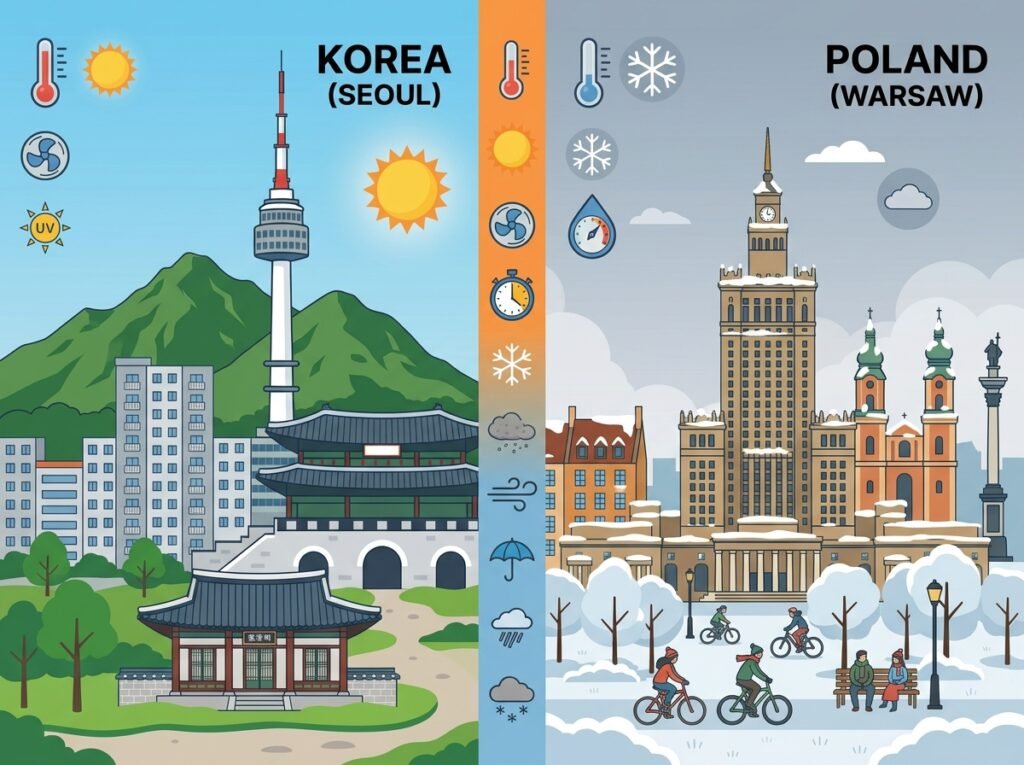

The way people use first names and surnames varies from country to country.
In Korea, it is customary to use a surname followed by a two-syllable given name. But when you live in Europe, you begin to notice that the way people address one another is different, and that surnames are used in different ways, too.
Polish names are more interesting than you might expect. At first, I thought of them simply as foreign names. But after living in Poland, meeting people, working here, and even choosing names for my children, I began to notice that Polish names have some similarities to Korean names, yet differ in many ways. And from a Korean perspective, some Polish names can be unexpectedly funny just because of how they sound.
So I have decided to tell the story of Polish names in two parts.
In this first post, I will share some of the characteristics of Polish names that I have noticed while living in Poland, along with a few amusing anecdotes, especially from a Korean perspective. In the second post, I will take a closer look at the linguistic and cultural features hidden within Polish names.
1. “Kim” in Korea, “Anna” in Poland?
Korea has a relatively small number of surnames. Since Kim, Lee, and Park account for a large proportion of the population, people tend to place more emphasis on a distinctive given name than on a surname when identifying someone. Of course, there are plenty of common given names in Korea, too, but these days, many parents seem to look for something a little more unique when choosing a name for their child. When several people have the same given name, it is quite natural to use their surnames as well to tell them apart.
In Poland, things often feel the other way around. There are tens of thousands of different surnames, making them quite diverse and distinctive. Given names, on the other hand, tend to come from a familiar pool of traditional names, such as Anna, Piotr, and Jan. As a result, I often get the impression that in Korea, people are distinguished and remembered by their given names, whereas in Poland, surnames play a more prominent role in identifying people.
For example, if someone in Korea calls out, “Kim!”, several people nearby might turn around.
The same thing can happen with common first names in Poland. Anna, in particular, is a very common name, so I imagine that if someone shouted “Anna!” in a crowded place, several people might respond at once.
That is why it can sometimes be difficult to tell who someone is just from their first name. You end up hearing their full name, including their surname, and only then do you think, “Oh, that person!”
The same thing happens when my eldest child talks about friends from kindergarten. There are two children named Stefan in the same class, so my child uses their surnames when talking about those two boys. Moments like this make me realize just how much having a common name can affect everyday life.
2. Taking a Husband’s Surname After Marriage—and How Things Are Changing
As in many other Western countries, the traditional practice in Poland has been for a woman to take her husband’s surname when they marry. However, more and more women are choosing to keep their original surnames or combine their surname with their husband’s in a hyphenated surname.
One possible reason is that, as more women pursue higher education and build careers, they may want to maintain their professional identities. Researchers, for example, may want to keep publishing under the same name, while professionals may prefer to retain the recognition they have already established under their original surname. Others make their choice for personal, family-related, or practical reasons.
I know of one particularly interesting case. A friend of mine told me that his wife’s family had only daughters, and they were concerned that their family surname might eventually disappear. So he decided to add his wife’s surname to his own, and they chose to give their children a hyphenated surname as well, preserving her family name for the next generation.
In my case, I chose to keep my original surname and give my children hyphenated surnames. First of all, I wanted to retain my surname in the Korean way because it is part of my identity. It was also convenient not to have to change my name on documents such as my passport and bank records. I had also heard that having a different surname from your children could sometimes cause confusion at daycare or kindergarten, so I decided to give the children a hyphenated surname.
3. Who Is the Polish Equivalent of “Hong Gil-dong”?
If you had to pick a common Polish name equivalent to Korea’s placeholder names like Hong Gil-dong or Kim Cheol-su, what would it be?
Many people would probably think of Jan Kowalski. Jan is a very common Polish male name, and Kowalski is also an extremely common surname.
In Korea, the name Hong Gil-dong feels less like the name of someone you would frequently meet in everyday life and more like a standard fictional name used in documents and examples.
Jan Kowalski serves a similar purpose in Poland. The name appears in bank forms and sample documents when a fictional person is needed. It can also be used in a general sense, much like “John Doe” in English, when referring to an unspecified person.
When I first learned about this name, I thought, “Oh, so Poland has its own Hong Gil-dong!” I found that quite amusing.
A typical male example is Jan Kowalski, while a common female example is Anna Kowalska. Given that both the first names and surnames are common, they feel somewhat similar to Kim Cheol-su or Kim Young-hee in Korea.
4. How Can One Person Have So Many Different Names? Welcome to the World of Polish Diminutives
When I first arrived in Poland, there was something else about people’s names that confused me.
They were clearly the same person, yet their names kept changing. Someone I had met as Anna would be called Ania by one person and Anka by another. I would wonder, “Wait, is that someone else?” only to discover that they were all referring to the same person.
In Poland, people are often addressed not only by their full given names but also by affectionate or diminutive forms, known in Polish as zdrobnienia. This kind of naming is common in other Western cultures, too, but Polish diminutives can differ so much from the original name that, when you first hear them, it can be difficult even to realize that they refer to the same person.
Examples of female names
- Anna → Ania, Anka, Aneczka, Anulka
- Magdalena → Magda, Madzia, Magdusia, Magdalenka, Madziunia
- Aleksandra → Ola, Olka, Oleńka
- Małgorzata → Gosia, Małgosia, Małgośka, Gośka, Gosieńka, Gosiunia
- Agnieszka → Aga, Agusia
- Joanna → Asia, Aśka, Asiunia
Examples of male names
- Jan → Janek, Jaś, Jasiek, Janeczek
- Jakub → Kuba, Kubuś
- Krzysztof → Krzysiek, Krzyś, Krzysio
- Franciszek → Franek, Franio, Franuś
- Stanisław → Stasiek, Staś
- Tadeusz → Tadek, Tadzio
At first, this can be quite difficult to get used to. Not every name has diminutive forms, and the changes do not always follow a predictable pattern. If it were simply a matter of calling Robert “Rob,” as in English, it would be relatively easy to guess. But in Polish, the diminutive can look quite different from the original name. For someone new to Poland, learning people’s names can feel like a little homework assignment in itself.
And not everyone is always addressed by a diminutive. In business relationships and formal situations in particular, it is safer to use the person’s proper given name. Trying to sound friendly by immediately using a diminutive with someone you have just met can actually come across as disrespectful or overly familiar.
So when I meet someone new in a business setting, I use their full given name. Outside of business, I tend to pay attention to how other people address them and how they seem to prefer being called.
5. Polish Names That Make Korean Speakers Burst Out Laughing
Some Polish names and diminutives happen to sound remarkably similar to Korean words, making them unintentionally funny to Korean ears.
- Ania: A diminutive of Anna. It sounds like aniya (아니야), meaning “No, that’s not it” in Korean.
- Monia: A diminutive of Monika. It sounds like mwoya (뭐야), meaning “What is it?” or “What the heck?”
- Madzia: A diminutive of Magdalena. It sounds like maja (맞아), meaning “That’s right”
- Doma: A diminutive of Dominika. It brings to mind a doma (도마), the Korean word for a cutting board.
- Tadzio: A diminutive of Tadeusz. It sounds like tajo (타조), the Korean word for an ostrich.
- Henio: A diminutive of Henryk. It sounds like haenyeo (해녀), the Korean word for the female divers of Jeju Island.
- Benio: A diminutive of Benjamin. Its Korean-like sound can lead to some rather awkward associations!
6. Small, Funny Stories Experienced by Foreigners
When browsing expat communities, you sometimes come across amusing stories involving Polish names.
One Korean person shared a story about hearing someone speak in Poland and briefly thinking they were being greeted with “Ni hao!” The person assumed it was a Chinese greeting and felt offended, only to discover that the word they had heard was actually Michał, a Polish male name pronounced roughly “Mee-how.” It is an ordinary name to Polish speakers, but to someone unfamiliar with Polish, it can sound like something completely different.
In another expat-community post, someone wondered, “Why does it seem like every dog in Poland is named ‘Hotchi’?” It turned out that what people kept saying when calling their dogs was not a name at all, but the Polish word chodź, meaning “come” or “come here.” The dogs were not all named Hotchi. Their owners were simply telling them to come over again and again!
7. Choosing Baby Names in an International Marriage
Choosing a name for a child in an international family can be more complicated than you might expect. A name that sounds beautiful and natural in one language may be difficult to pronounce or sound completely different in the other. Finding a name that feels natural and is easy to say in both languages is one of the little challenges international couples face.
We had a similar experience in our family. As a mother raising three boys, I was repeatedly encouraged by my mother-in-law to name our third son Jaś. It is a familiar and affectionate-sounding name in Poland, but to my Korean ears, it had a rather different feel.
In the end, even choosing a single name meant considering both Korean and Polish at the same time.
When choosing our children’s names, we used the following criteria:
- Find a Polish name that sounds natural when pronounced in Korean, ideally with two syllables.
- If possible, create a shared element among the brothers’ names, similar to the Korean tradition of using a common syllable in siblings’ names.
Final Thoughts
Before living in Poland, I thought a name was simply a word used to call someone.
But after experiencing everyday life here, I came to realize how much of a country’s language and culture can be found in a single name. Which names are common, how they are shortened, what happens to surnames after marriage, and how people adapt their names when living abroad—all of these things show that names carry meaning beyond simply identifying someone.
In this post, I have shared some of the characteristics of Polish names that I have noticed while living in Poland, along with a few amusing anecdotes from a Korean perspective.
But it would be a shame to end the story here. There is still so much more to explore about Polish names, especially their linguistic and cultural background.
In the next post, I will take a closer look at the language and culture hidden within Polish names.